


Key takeaways
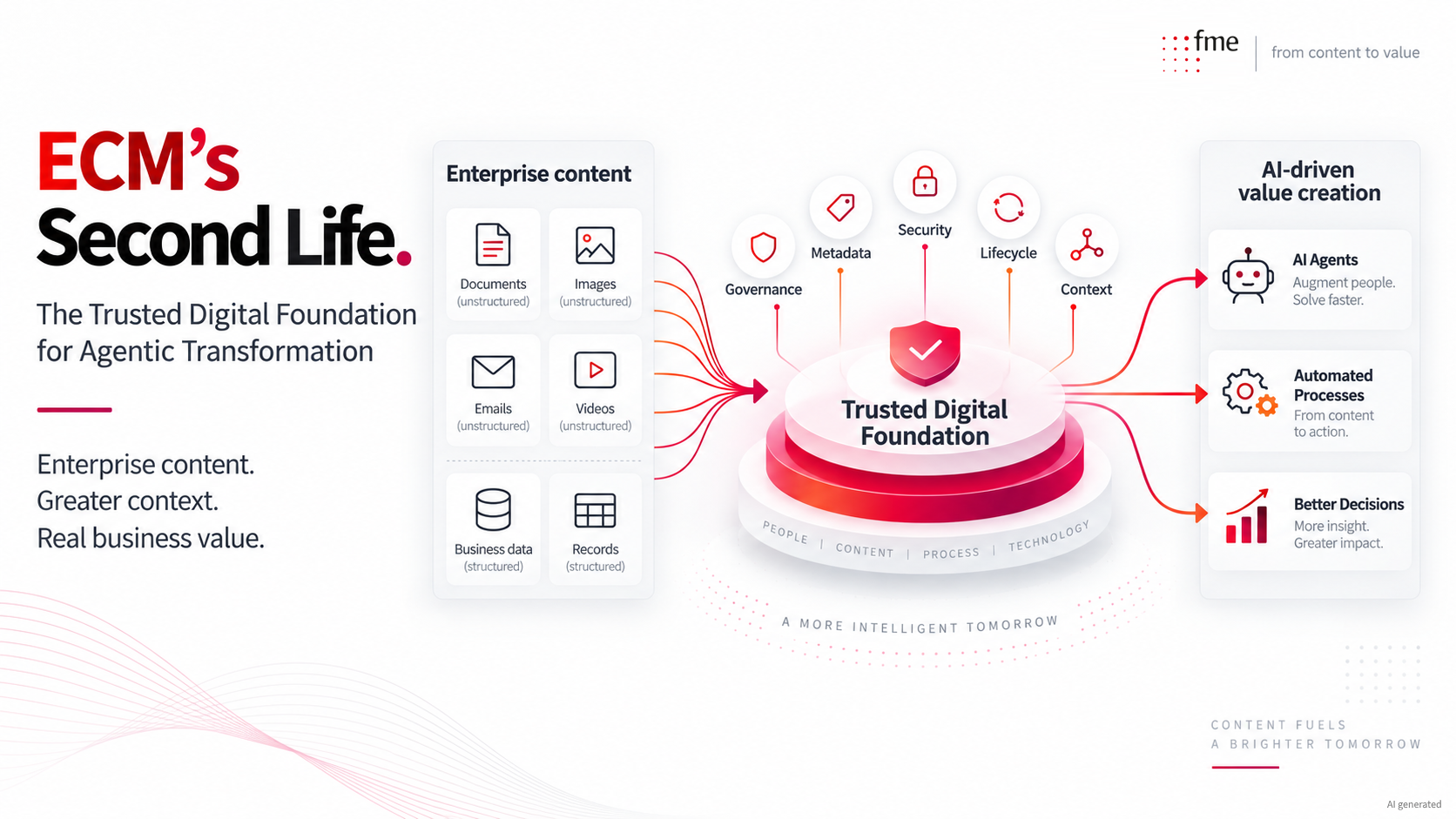
- Enterprise Content Management (ECM) is shifting from a system that stores and protects documents to a trusted digital foundation for AI-driven value creation.
- Enterprise AI needs more than the ability to read a document. It needs context: document type, currency, business relationship, ownership, access rights, confidentiality and retention.
- Operating an ECM system does not make enterprise content AI-ready. Connecting AI to existing repositories exposes and amplifies years of accumulated information management problems.
- A trusted digital foundation rests on five principles: understand and clean up, create context, establish security and lifecycle governance, modernize the ECM landscape, and validate the result.
- Content migration is the natural moment to make content AI-ready, because content is already being analyzed, transformed and moved.
Why ECM is getting a second life
For many years, Enterprise Content Management (ECM) has often been perceived as necessary infrastructure.
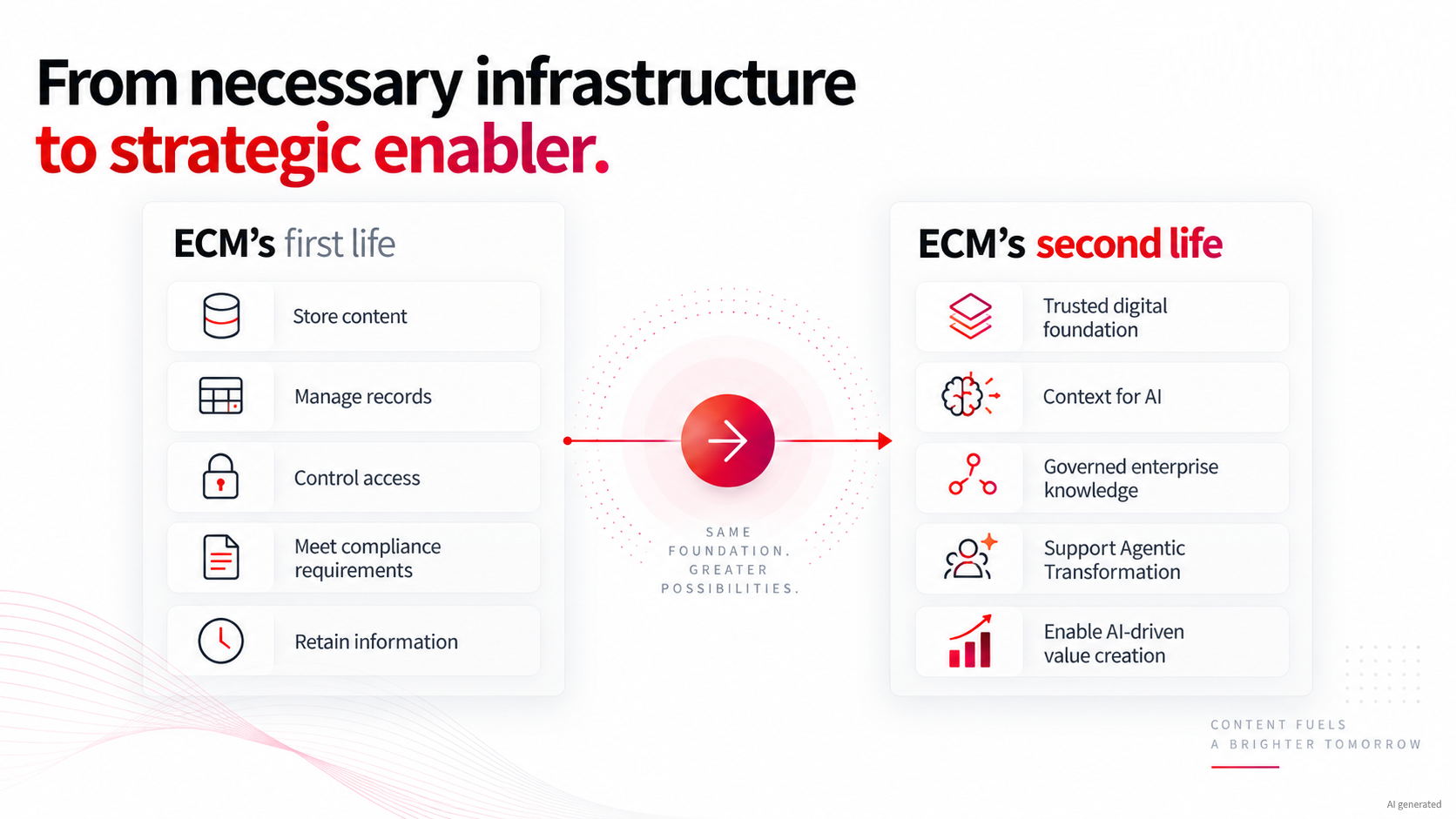
Organizations needed ECM to store documents, manage records, control access, meet compliance requirements, and retain information. It was important, but rarely considered a major driver of innovation or business value. Artificial Intelligence (AI) is changing that.
As generative AI evolves toward Agentic AI, enterprise content is no longer simply information that needs to be stored and managed. It is becoming an active input into digital work, automated decisions, business processes, and AI-driven services.
Definition — Agentic Transformation:
the evolution toward AI agents that can reason, plan, and act across enterprise processes and systems – reshaping how people, information, applications, and AI work together to create value.
The capabilities that have always been at the heart of ECM – structure, metadata, permissions, lifecycle management, governance, and trusted access to information – are becoming fundamental requirements for enterprise AI.
What was once primarily a system to manage content is increasingly becoming a trusted digital foundation for AI-driven value creation.
From managing content to enabling AI
Enterprise AI does not operate in isolation. Whether it works through retrieval-augmented generation (RAG), copilots or autonomous agents, it needs access to organizational knowledge: contracts, policies, SOPs, engineering documentation, quality records, reports, product information, project documentation, and millions of other documents.
Much of this knowledge exists as unstructured content – unstructured data held in documents rather than in database records. But being able to read a document is only the beginning. To create reliable business value, AI also needs context.
What type of document is it? Is it current and authoritative? What customer, product, asset, or process does it belong to? Who is allowed to access it? Is it confidential? How long should it be retained? And can an AI agent safely use it to recommend a decision or trigger an action?
These are not primarily AI questions. They are information management questions, and exactly the questions modern ECM is designed to address. Modern ECM connects content with context, access rights, lifecycle rules, and governance.
Agentic Transformation does not reduce the importance of ECM – it makes ECM strategically relevant again.
You don’t need to wait for a mature AI strategy
Many organizations are still at an early stage of using AI strategically. They may be experimenting with generative AI, introducing copilots, or exploring where AI can create meaningful business value.
Organizations do not need to know every future AI use case before improving their information foundation. Better structured, governed, current, and accessible content creates value today, regardless of which AI platforms, models, or agent architectures will be used tomorrow.
And as organizations move from generative AI toward Agentic AI, this becomes even more important. A generative AI application may produce an incomplete or incorrect answer when working with poor information. An AI agent can go further by recommending decisions, initiating workflows, interacting with systems, or executing actions.
Outdated policies, incorrect access rights, missing confidentiality classification, or poorly contextualized documents have a direct impact on AI-supported business processes.
The more autonomy we give AI, the more important, trusted enterprise information becomes.
Preparing that information today enables organizations to move faster when strategic AI opportunities emerge tomorrow.
Does having an ECM system mean your content is AI-ready?
No. Most large organizations already operate one or more ECM systems, but that does not automatically mean their content is ready for AI.
Enterprise information landscapes have evolved over years or decades. Content is distributed across legacy ECM platforms, file systems, collaboration environments, archives, cloud platforms, departmental applications, and acquired systems.
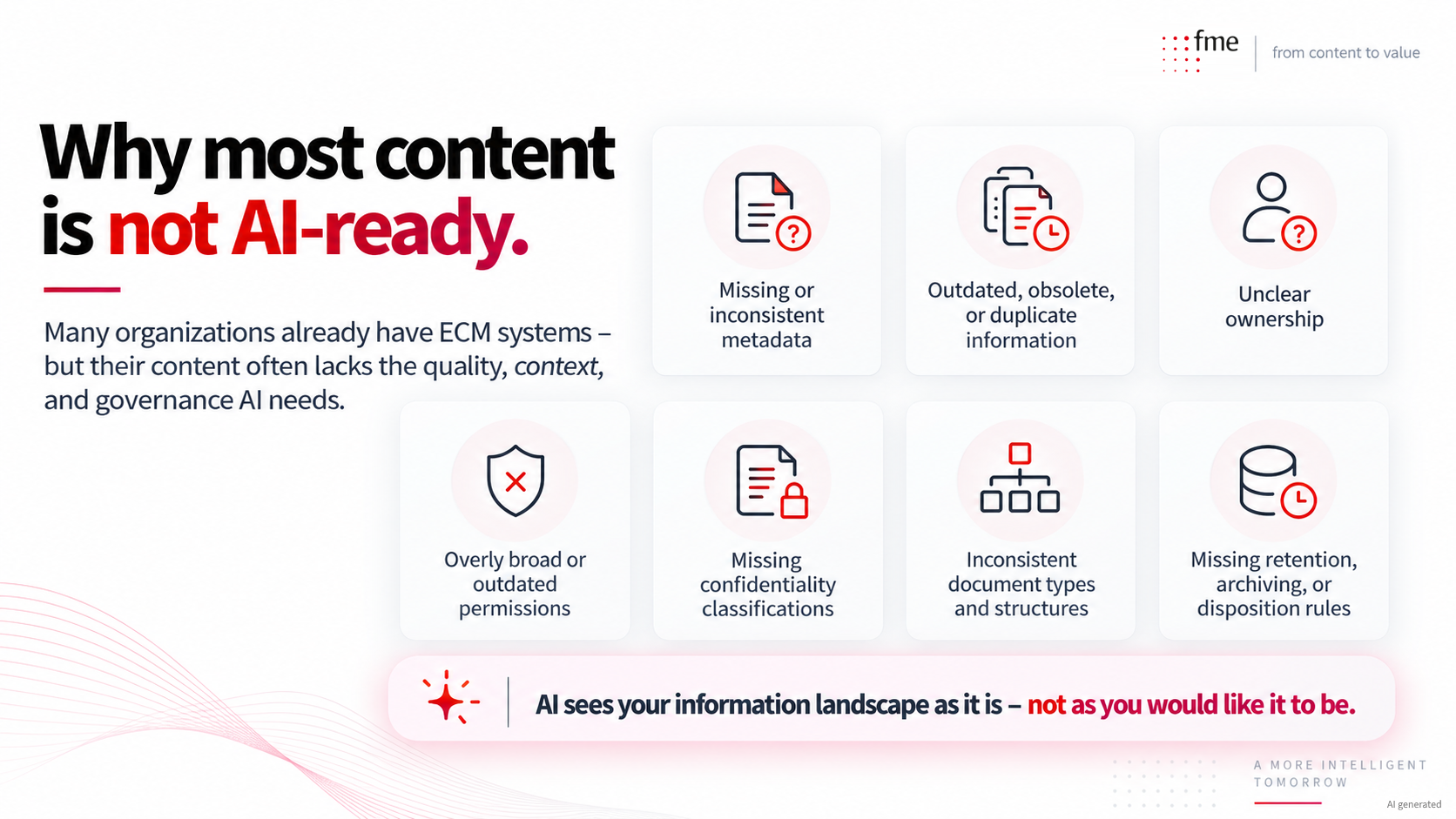
Even well-managed ECM environments can accumulate information quality and governance issues over time:
- Missing or inconsistent metadata and business context
- Outdated, obsolete, or duplicate information
- Unclear ownership
- Overly broad or outdated permissions
- Missing confidentiality classifications
- Inconsistent document types and structures
- Missing retention, archiving, or disposition rules
This creates a fundamental challenge:
AI sees your information landscape as it is, not as you would like it to be.
Connecting AI to existing repositories does not solve years of accumulated information management problems. It can expose and amplify them.
The goal should therefore not be to make as much content as possible available to AI. It should be to make the right content available, with the right context, to the right users and AI services, under the right governance.
From information debt to a trusted digital foundation
Definition — Information debt:
the accumulated impact of years of unmanaged content growth – including missing metadata, outdated or duplicate information, unclear ownership, overly broad permissions and missing lifecycle rules – that can limit the reliable use of enterprise content.
For many organizations, this means addressing years of accumulated information debt and modernizing how enterprise content is managed.
Definition — Trusted digital foundation:
enterprise content that is structured, contextualized, governed, current and access-controlled, so that people, business processes, applications and AI agents can rely on it.
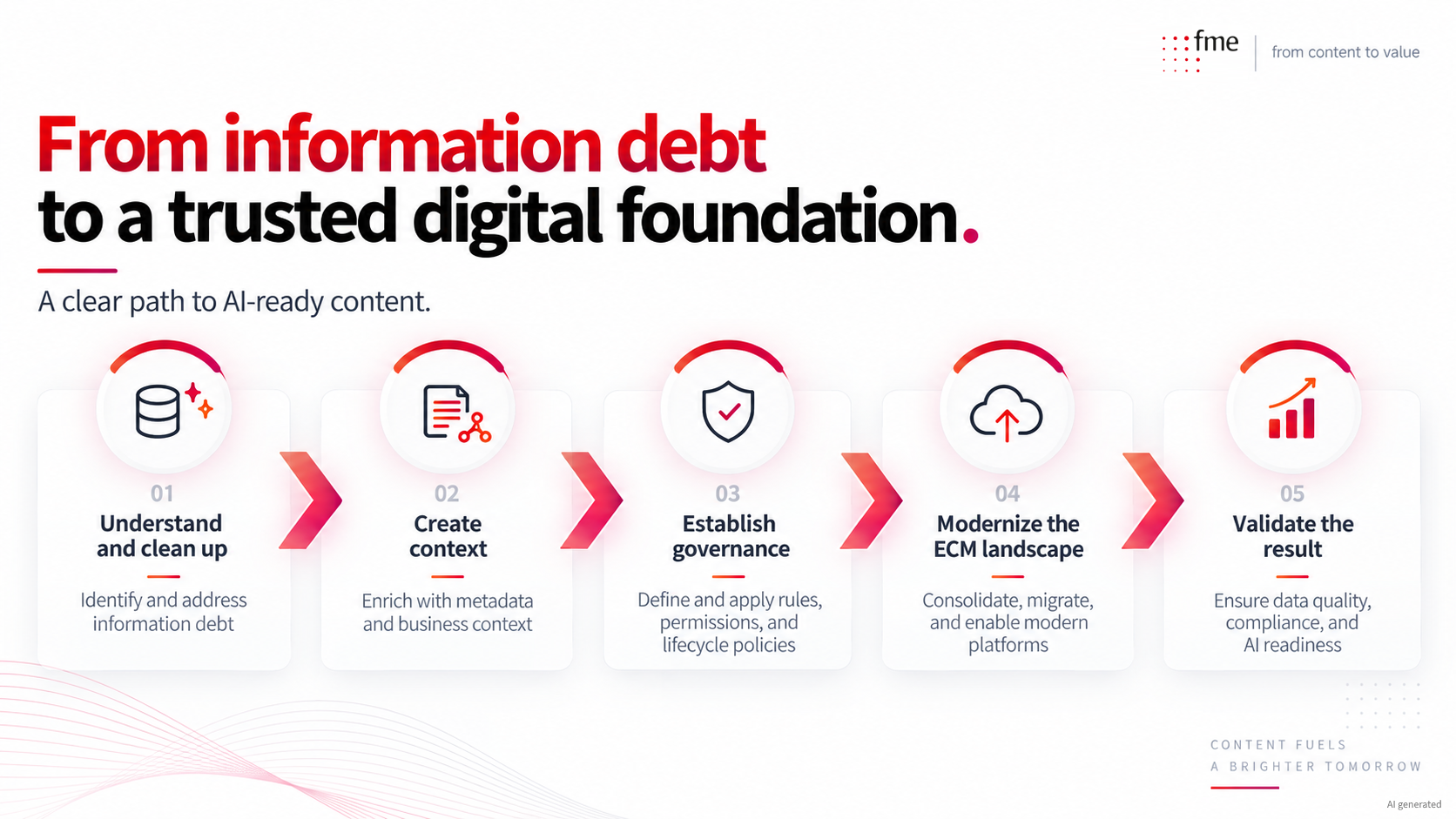
A trusted digital foundation is built on five key principles:
- Understand and clean up: Identify what information exists, what still has business value, and what is redundant, obsolete, or no longer required.
- Create context: Use document types, metadata, business classifications, ownership, confidentiality levels, and status information to make content understandable and usable.
- Establish security and lifecycle governance: Apply appropriate permissions, confidentiality rules, retention policies, archiving strategies, and disposition processes.
- Modernize the ECM landscape: Consolidate fragmented repositories and move relevant content from legacy environments into modern ECM, cloud, or archive platforms.
- Validate the result: Ensure that content, metadata, permissions, mappings, and transformations are correct and traceable.
The result is more than a modernized ECM environment. It is a trusted digital foundation for people, business processes, applications, and AI.
Why is content migration a strategic opportunity to make content AI-ready?
Because the content is already being analyzed, transformed and moved. Content migration therefore takes on a new strategic role.
Traditionally, migration projects have often been viewed primarily as technical initiatives: extracting documents from one system and importing them into another. But simply moving existing information problems to a new platform creates limited long-term value.
A migration project provides a unique opportunity to improve content while it is already being analyzed, transformed, and moved. Organizations should use this transition to eliminate unnecessary information, enrich metadata, introduce better classifications, harmonize structures and permissions, implement lifecycle rules, consolidate repositories, and archive content that no longer belongs in the active environment.
Alongside established drivers such as cloud migration, consolidation, M&A, decommissioning, regulatory requirements, and continuous platform change, AI readiness is therefore becoming an increasingly important outcome of ECM modernization and migration initiatives.
Content migration is no longer only about moving from one system to another. It serves as a strategic enabler to build the trusted information foundation for future AI adoption.
How does fme support your Agentic Transformation journey?
Building a trusted digital foundation requires more than technology. Organizations need to understand where AI and Agentic AI can create business value, what information these use cases depend on, and how their content landscape needs to evolve.
As fme AG, an IT consultancy and software company headquartered in Braunschweig, Germany, we support this journey with expertise across AI and Agentic AI business cases, ECM strategy and platform selection, content and information management, governance, migration strategy and execution, and validation.
From defining the right target environment to transforming existing content, fme helps organizations connect their AI ambitions with the information foundation required to make them successful.
How migration-center helps build the trusted digital foundation
migration-center is fme’s enterprise content migration platform, supporting the complete migration workflow: from understanding and preparing source content to transforming, migrating, and validating it in the target environment.
Its three complementary editions can be used individually or together across the entire migration lifecycle.
-
Classify – Understand and prepare
migration-center – Classify™ uses AI to identify document types, enrich metadata, and create the context needed for migration, governance, and future AI use cases.
-
Migrate – Modernize and transform
migration-center – Migrate™ moves and transforms enterprise content and metadata across ECM, cloud, and archive platforms. It helps harmonize structures and information models instead of simply reproducing legacy environments.
-
Verify – Validate and prove
migration-center – Verify™ validates migrated content, metadata, and transformations against the source, providing transparent evidence that the migration result is complete and correct.
Together, Classify, Migrate, and Verify turn content migration into more than a technical move by creating a cleaner, better structured, better governed, and more trustworthy digital foundation for Agentic Transformation.
ECM’s second life has already begun
ECM’s traditional responsibilities (managing, protecting, and retaining enterprise content) remain important. But AI adds a new dimension. Enterprise content is becoming an active resource for digital assistants, knowledge services, automation, and increasingly autonomous agents.
ECM’s first life was about managing enterprise content. Its second life is about turning that content into a trusted foundation for AI-driven value creation. Organizations do not need to know exactly what their AI landscape will look like in five years. But they should make sure today that their information is usable, governed, secure, current, and trustworthy.
Models will change. AI platforms will change. Agent architectures will change.
Your enterprise knowledge will remain.
Agentic Transformation therefore does not begin with an agent. It begins with the information that agents will depend on. Now is the time to prepare it.
With fme’s ECM, AI, and migration expertise and the migration-center platform, you are able to identify valuable AI use cases, define the right content and platform strategy, enrich your information, and modernize your content landscape while preparing your organization for its Agentic Transformation journey.
Ready to build the trusted digital foundation for your Agentic Transformation journey?
Talk to us about your current content landscape and discover how fme and migration-center help you prepare for what comes next.
Frequently asked questions
What is a trusted digital foundation for AI?
A trusted digital foundation is enterprise content that is structured, contextualized, governed, current and access-controlled, so that people, business processes, applications and AI agents can rely on it. It is built on five principles: understand and clean up, create context, establish security and lifecycle governance, modernize the ECM landscape, and validate the result.
Does having an ECM system mean your content is AI-ready?
No. Most large organizations already operate one or more ECM systems, but content is typically spread across legacy platforms, file systems, collaboration environments, archives and acquired systems, with inconsistent metadata, outdated permissions and missing retention rules. Connecting AI to those repositories does not resolve these problems; it exposes and amplifies them.
Do we need an AI strategy before we improve our content?
No. Organizations do not need to know every future AI use case before improving their information foundation. Better structured, governed, current and accessible content creates value today, regardless of which AI platforms, models or agent architectures are used tomorrow. Preparing information now allows faster action when strategic AI opportunities emerge.
Why does agentic AI raise the stakes compared with generative AI?
A generative AI application working with poor information may produce an incomplete or incorrect answer. An AI agent goes further: it recommends decisions, initiates workflows, interacts with systems and executes actions. Outdated policies, incorrect access rights or missing confidentiality classifications therefore have a direct impact on AI-supported business processes.
What are the five principles of a trusted digital foundation?
Understand and clean up: identify what information exists and what is redundant or obsolete. Create context: apply document types, metadata, classifications, ownership and confidentiality. Establish security and lifecycle governance: permissions, retention, archiving and disposition. Modernize the ECM landscape: consolidate fragmented repositories. Validate the result: prove that content, metadata and transformations are correct and traceable.
Why is a content migration project the right moment to prepare content for AI?
Because the content is already being analyzed, transformed and moved. That transition can be used to eliminate unnecessary information, enrich metadata, introduce better classifications, harmonize structures and permissions, implement lifecycle rules, consolidate repositories and archive inactive content. Simply moving existing information problems to a new platform creates limited long-term value.
What is migration-center?
migration-center is fme’s enterprise content migration platform, supporting the complete migration workflow from understanding and preparing source content through transforming and migrating it to validating it in the target environment. Its three editions — Classify, Migrate and Verify — can be used individually or together across the entire migration lifecycle.
0 Comments